$56.63
$86.08
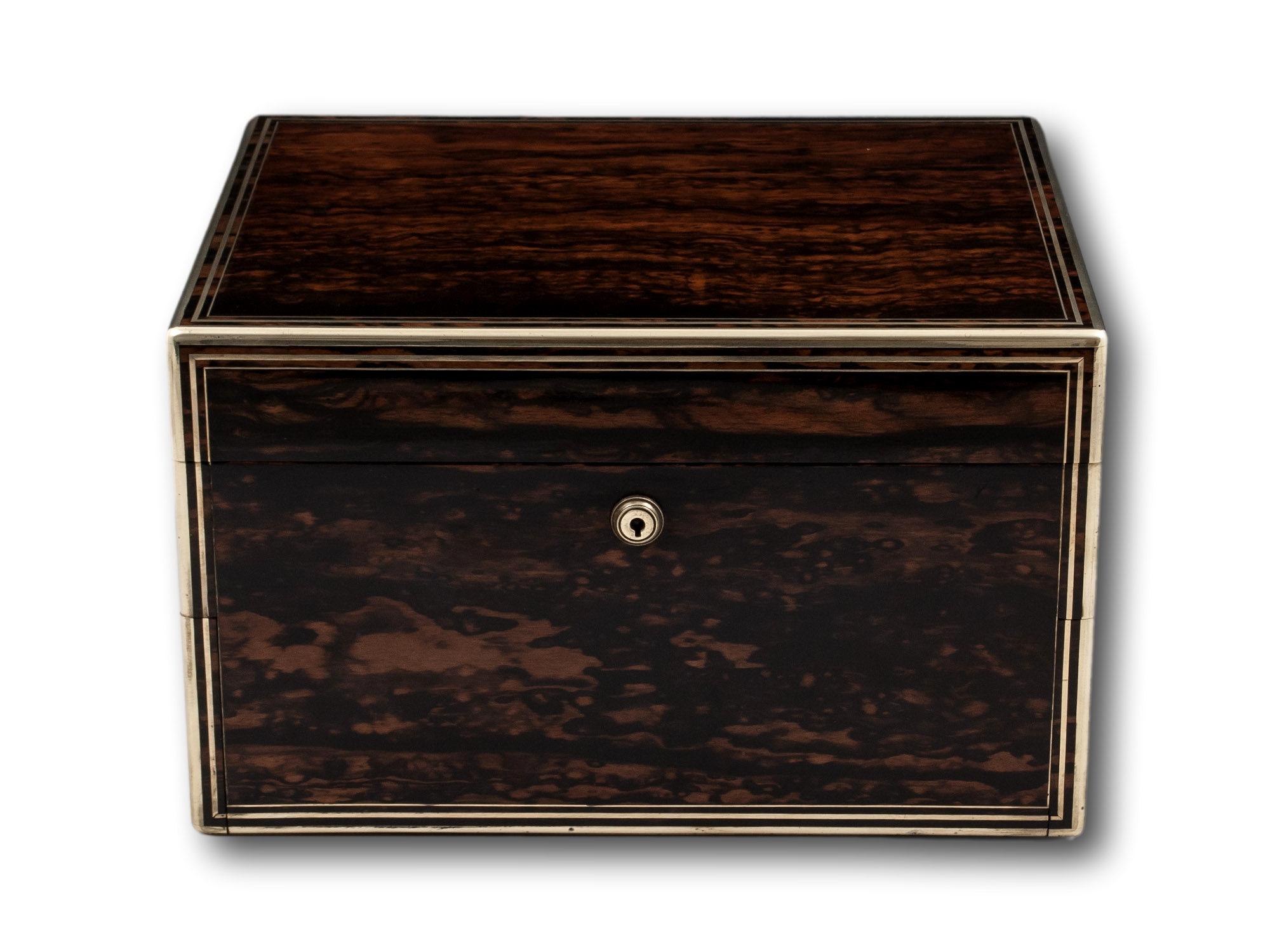
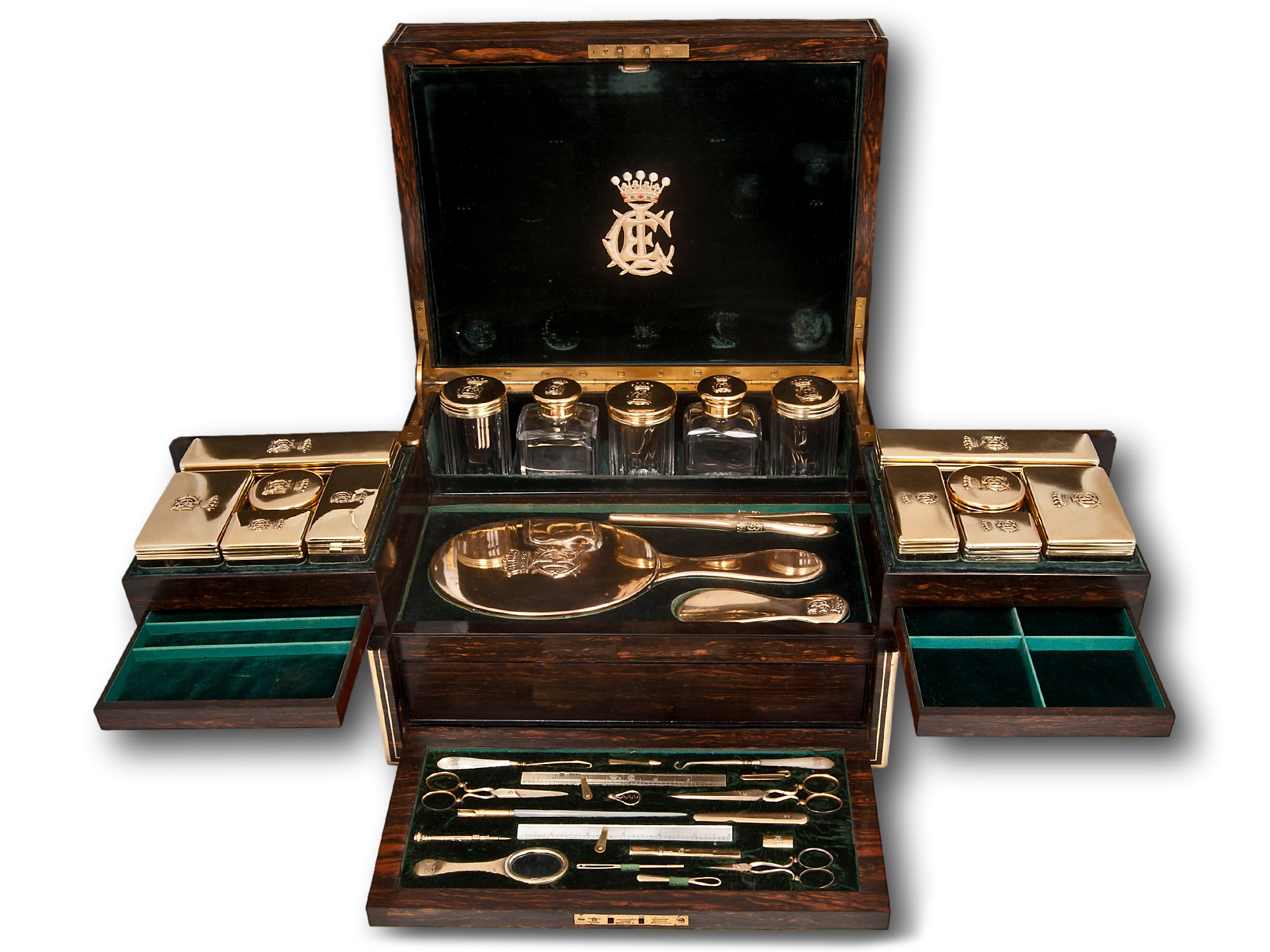
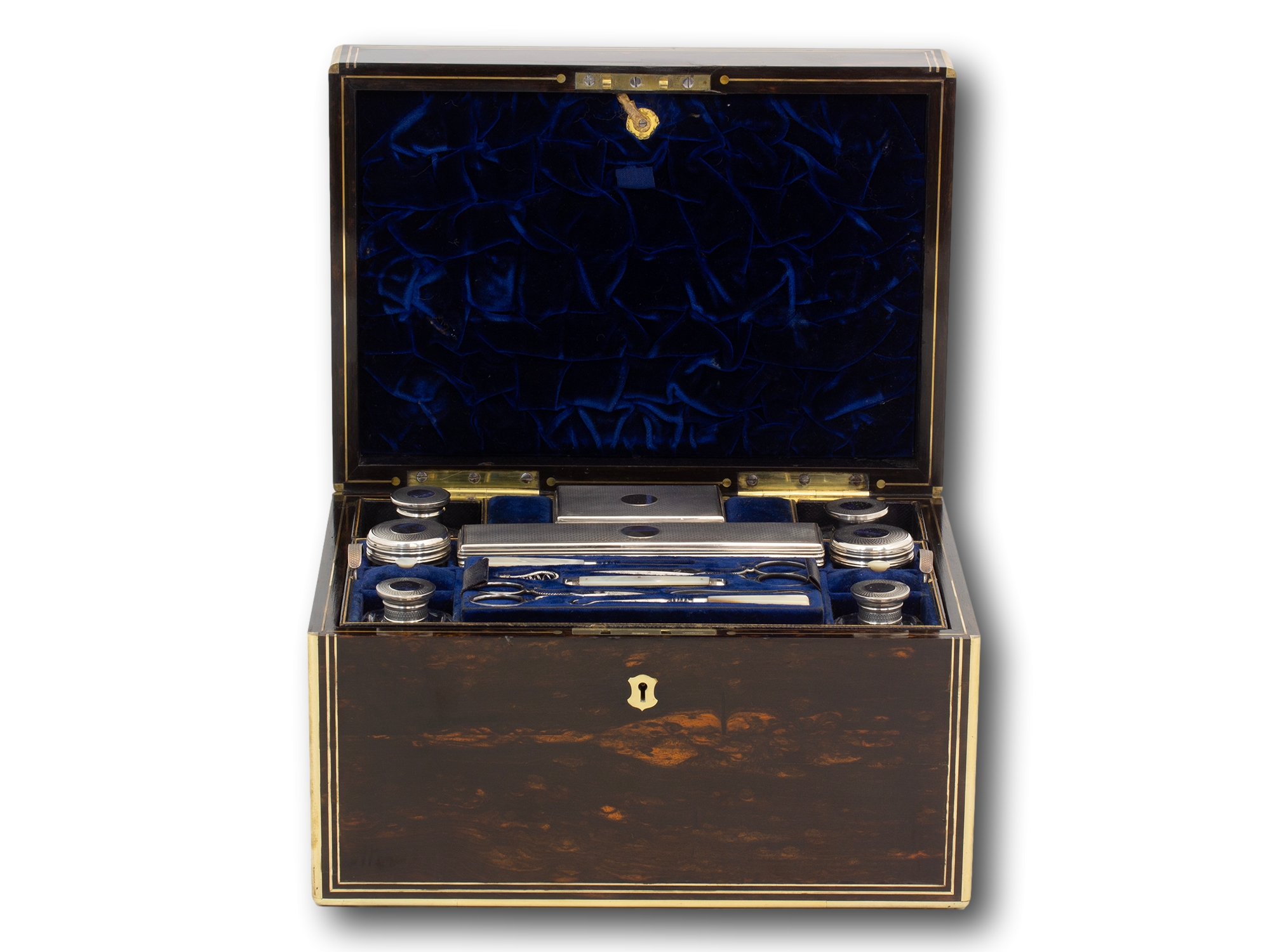
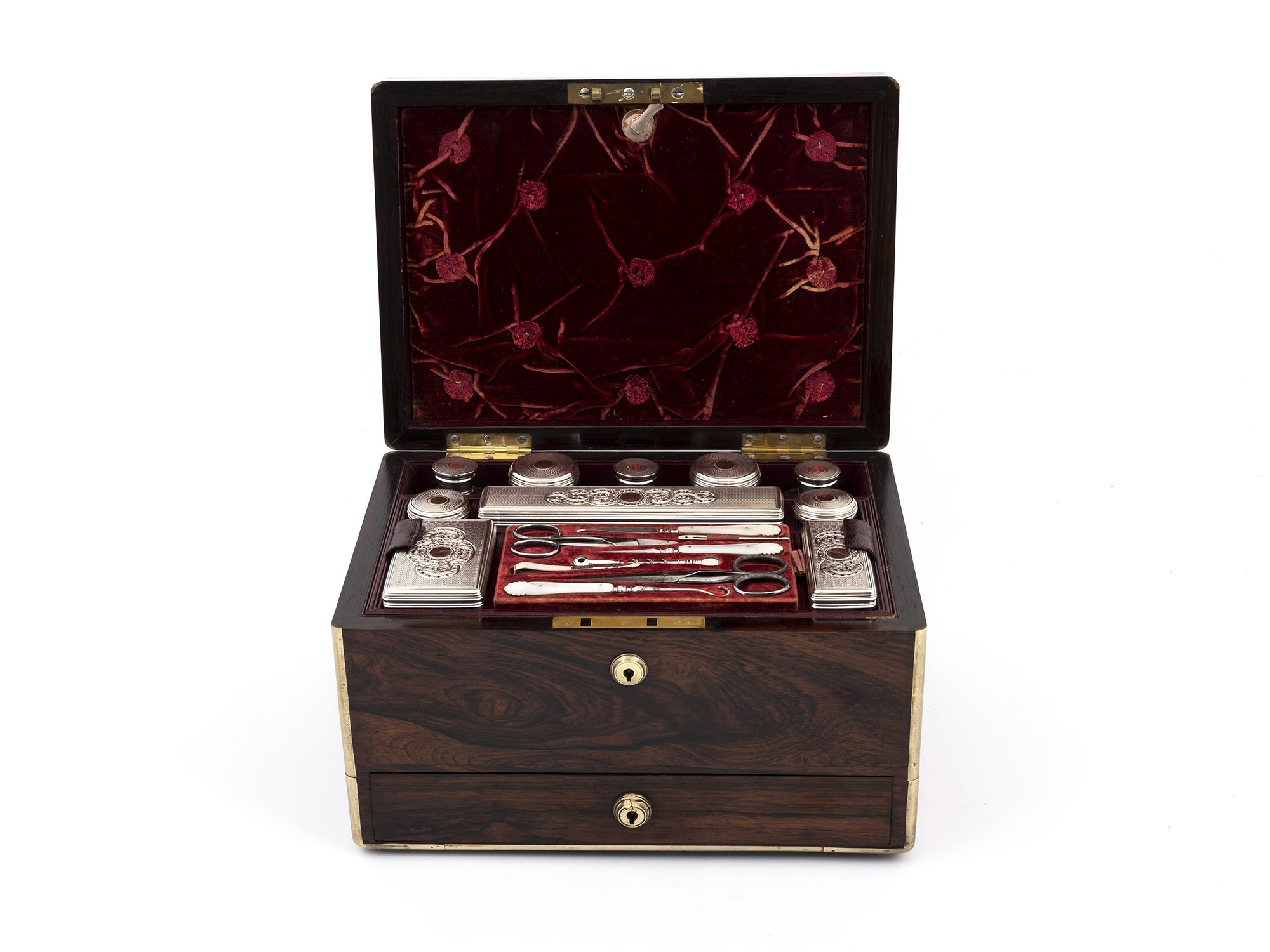
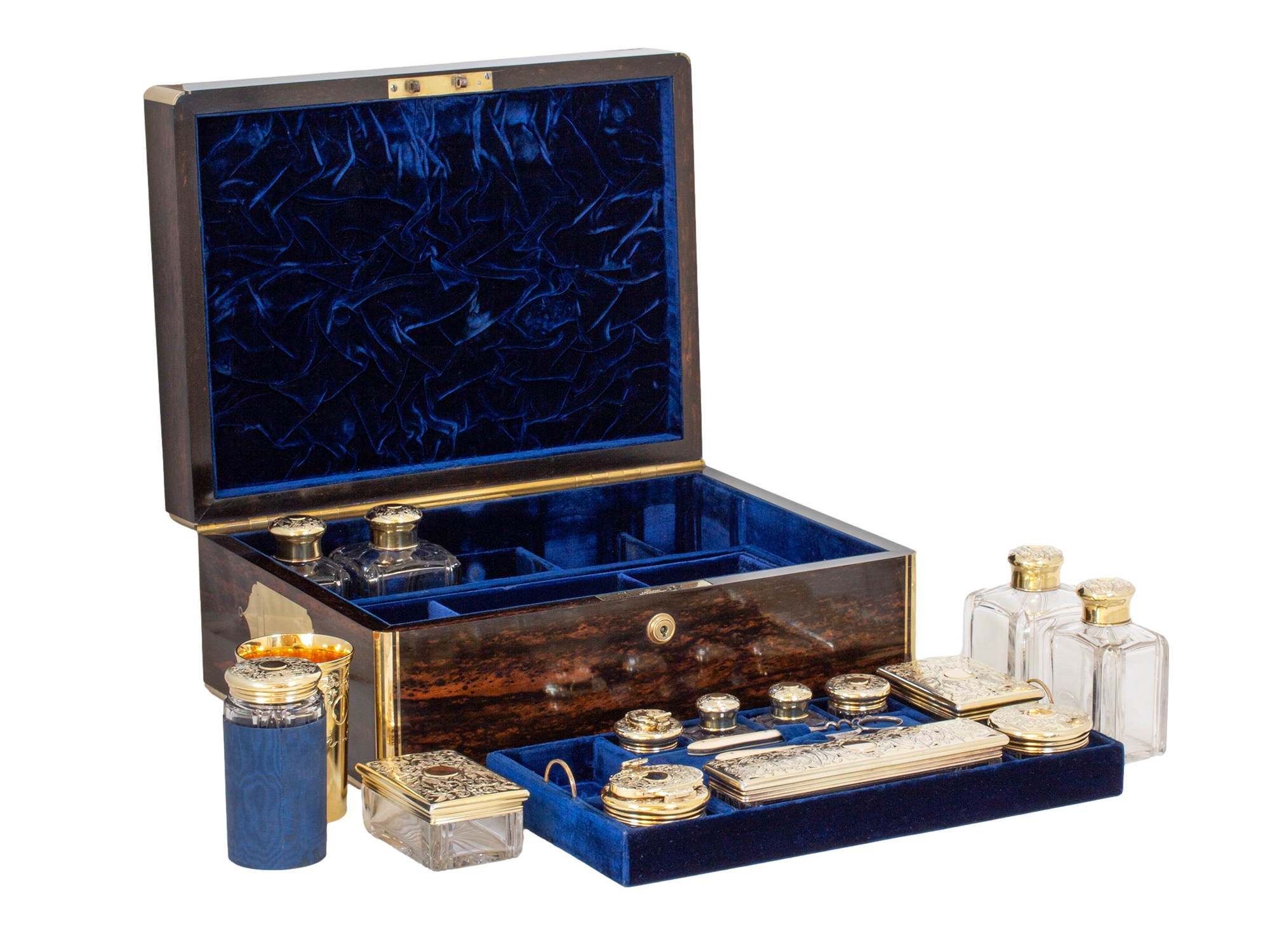
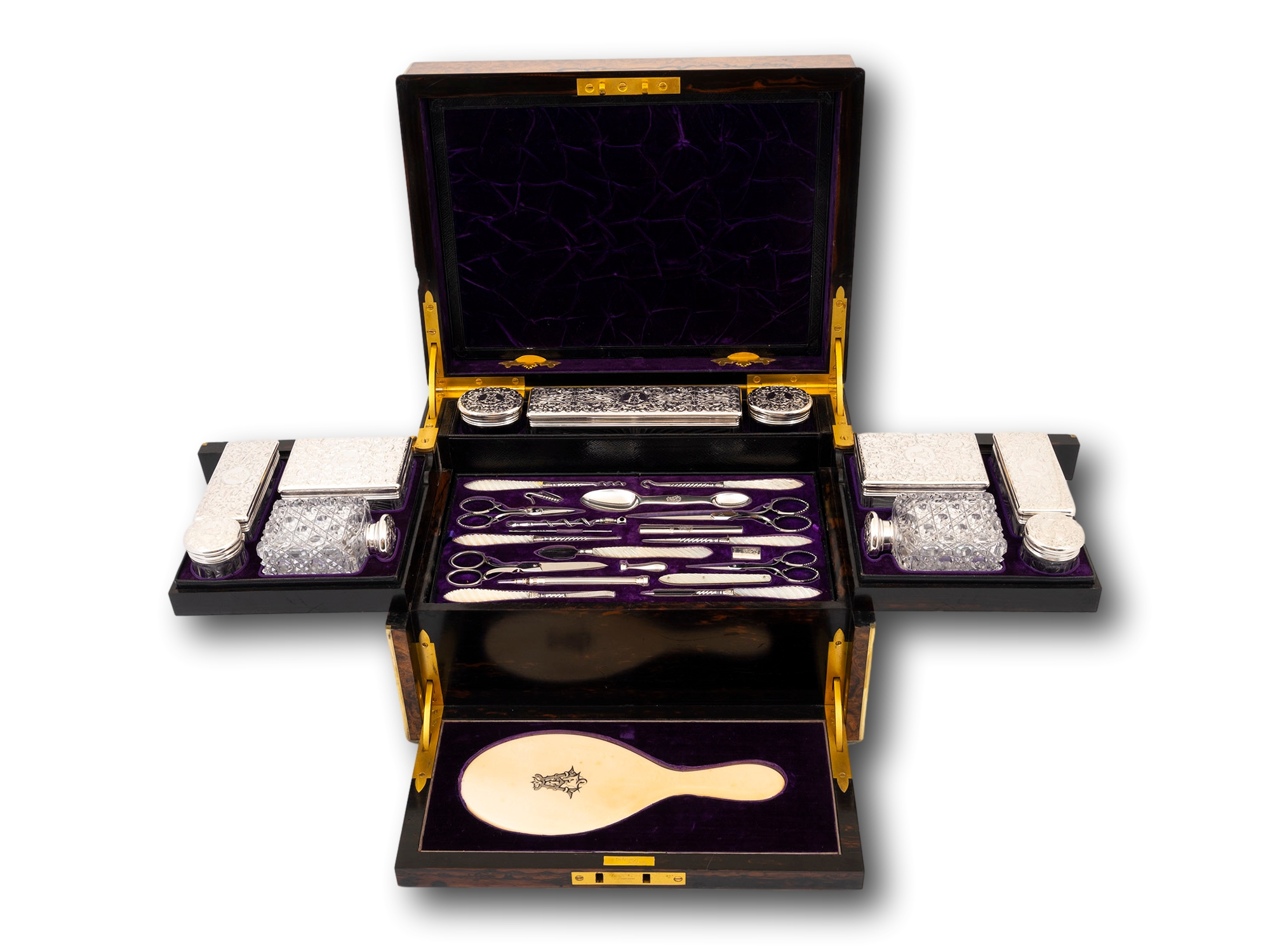
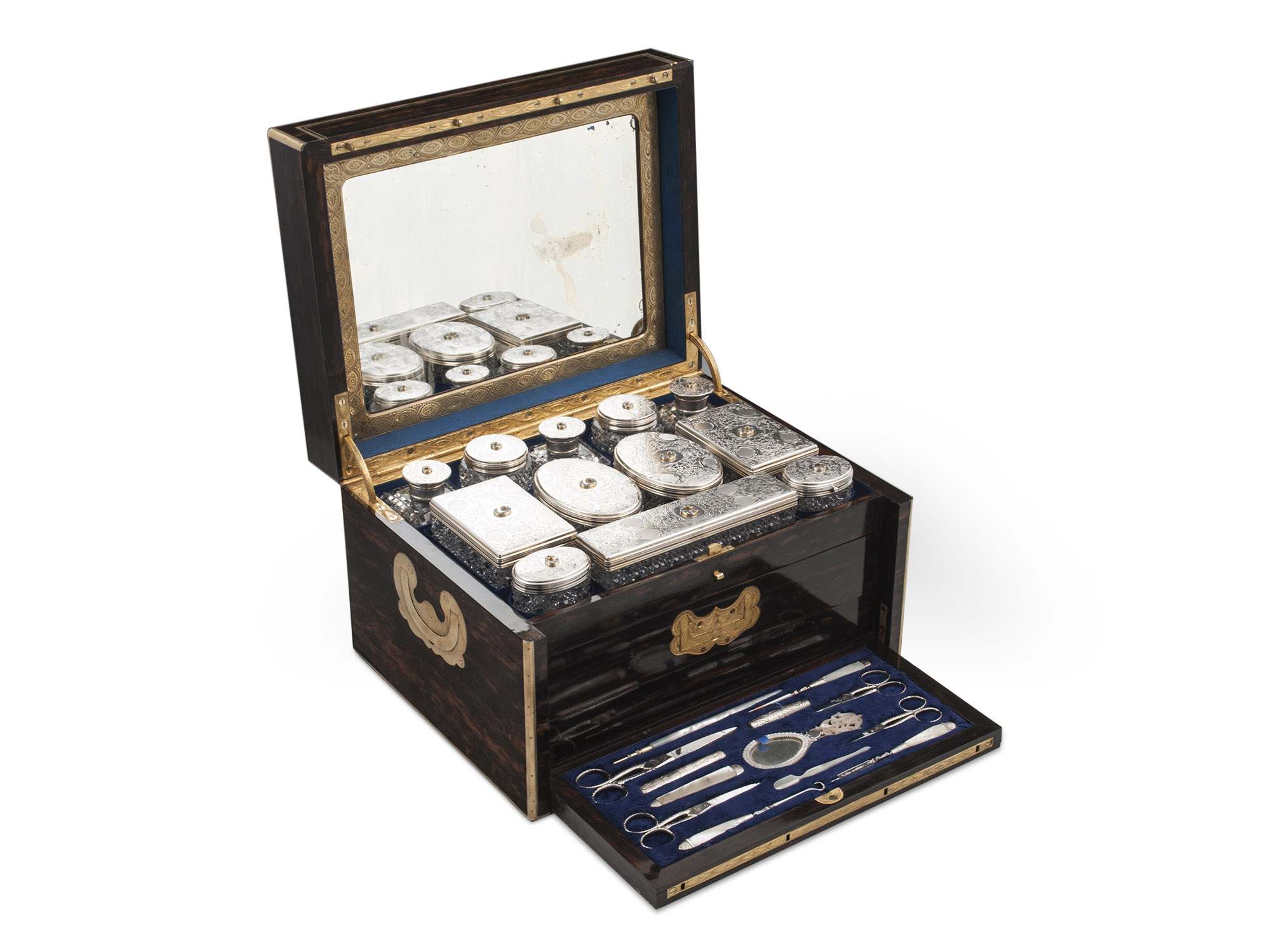
Description Large and Impressive Vanity Box by George Betjemann & Sons retailed by Jenner & Knewstub From our Vanity Box collection, we are delighted to offer to the market this extremely impressive Vanity Box by renowned London cabinet makers George Betjemann & Sons. The vanity box is veneered in exotic coromandel to the exterior with beautifully engraved brass strapping and corner mounts, a subtle barrel escutcheon and initial plaque to the lid. The interior of this spectacular vanity box features a self standing inner lid mirror faced in coromandel with ruched velvet and ormolu mounts covering a removable documents folder with gold tooling and engraved lock. The first layer displays a collection of fifteen hobnail cut glass jars with silver gilt lids having extensive floral engravings all fitted within a trefoil gallery. Dropping down the front panel reveals three silver gilt mirrors fully engraved with the original mirror plates. The top layer is split into two halves and pivots outwards revealing an extensive vanity set which includes a central horseshoe clock and matching barometer surrounded by various sewing tools including scissors, vinaigrettes and thimbles. Each of the individual pieces carrying the monogram of the original owner matching the exterior and contain hallmarks for George Betjemann & Sons dated 1878. To the centre base above the mirrors is a mechanical latch which activates the tiers of the vanity box ejecting the final tiers outwards allowing access to the bidden compartments which are located beneath the tools. Each compartment is activated by buttons between the top and middle tier and contain lined jewellery trays. The base contains brushes and glass lined boxes with two further storage drawers in the rear. The box is signed twice by the retailer Jenner & Knewstub, 33 St. James St. G Jermyn St. To the Queen and manufactured by George Betjemann & Sons. The Vanity Box is one of the hight examples made by George Betjemann & Sons showing their incredible talent in exotic materials and design. Literature We are delighted to offer this vanity box as part of our Exceptional Collection catalogue featured on page 32-33. George Betjemann & Sons George Betjemann & Sons stood among the finest London makers of dressing cases, writing boxes and luxury furnishings throughout the 19th century, with a reputation built on precision, innovation and elegant design. The company began with George Betjemann (1798-1886), who was apprenticed in 1810 to Gilbert Slater, a respected dressing case maker. Betjemann soon established his own workshop in Clerkenwell, a hub for cabinet-making and fine metalwork at the time. By 1865, the business had grown significantly and was operating under the name George Betjemann & Sons, with addresses at 36 and later 36-40 Pentonville Road. The firm remained in family hands for generations, employing over a hundred craftsmen at its peak. George’s sons, believed to be G.W. and J. Betjemann, joined the business and brought with them a spirit of technical innovation, filing several patents for improvements in box construction and display fittings. At the 1878 Paris International Exhibition, Betjemann & Sons showcased their remarkable range: self-closing book slides, expanding dressing cases, writing sets in exotic veneers, and engraved gilt metalwork in a neo-Gothic style. Their decorative objects extended well beyond boxes, the firm also produced photographic frames, albums, candelabra, silver étuis, clocks, and scent bottle stands. These often incorporated high-end materials such as Algerian onyx, malachite, and richly figured marbles, a nod to the firm’s affinity for both English craftsmanship and Continental flair. Throughout their history, Betjemann & Sons continually expanded both their range and reputation. Patents were filed for everything from folding games boxes to decanter stands, while bespoke commissions were crafted for an elite clientele. A notable example is a satinwood dressing table designed by Ernest Edward Betjemann, incorporating a concealed safe and patented in 1910. The firm’s reach also extended to financial dealings in the trade. G. Betjemann acted as trustee in the liquidation of several competing London case makers, including Toulim & Gale and P. F. Schafer, consolidating his position in a competitive market. Though the company eventually ceased operations in the early 20th century, its legacy endures. George Betjemann was the great-grandfather of the poet Sir John Betjeman, whose own nostalgia for craftsmanship and English domesticity seems a fitting echo of the family’s tradition. Today, Betjemann boxes are prized for their exceptional build quality, inventive mechanics, and distinctive style. Whether a writing slope, games compendium or dressing case, these pieces remain among the finest examples of 19th-century portable luxury. Jenner & Knewstub Founded around 1856 by Frederick Jenner and Fabian James Knewstub, the firm began at 33 St James’s Street before moving to 66 Jermyn Street in 1862. They quickly established a strong reputation, exhibiting their work at the International Exhibition of 1862 and later at the Paris Exposition of 1878. Royal recognition followed, and they were granted multiple warrants, including from Queen Victoria and the Russian Imperial family. It is not certain when Charles Louis Faber entered into partnership, but his retirement in 1886 left Jenner and Knewstub to continue the business. Just a few years later, in 1889, the company went into liquidation and was absorbed by A. Webster and Co. at 60 Piccadilly. The name Jenner and Knewstub lived on as a limited company under the new ownership. Coromandel Also known as Calamander is a valuable wood found in India, Sri Lanka and South East Asia. It has a contrasting hazel-brown colour with black grain. It is a dense, heavy wood that is so popular it has been logged to extinction over the last few hundred years. This makes Calamander pieces even more special. If you are purchasing Tortoiseshell or Ivory pieces and are outside the UK you must have a CITES certificate in order to import the item into your country. We can obtain these on your behalf at a cost of £50 and these can take up to 30 working days to arrive at our office. Due to the strict exporting rules of these pieces, they may also come with further shipping costs. Please ensure you contact us prior to purchase for a quote. With every purchase from Mark Goodger Antiques, you will receive our latest catalogue, a Certificate of Authenticity, detailed care instructions for your chosen piece and an independent invoice (for insurance purposes) will be enclosed. As well as being protected by a no-hassle, money-back policy, your piece will be entirely insured during the shipping process to ensure the safety of your item.
Vanity Boxes