$78.23
$114.21
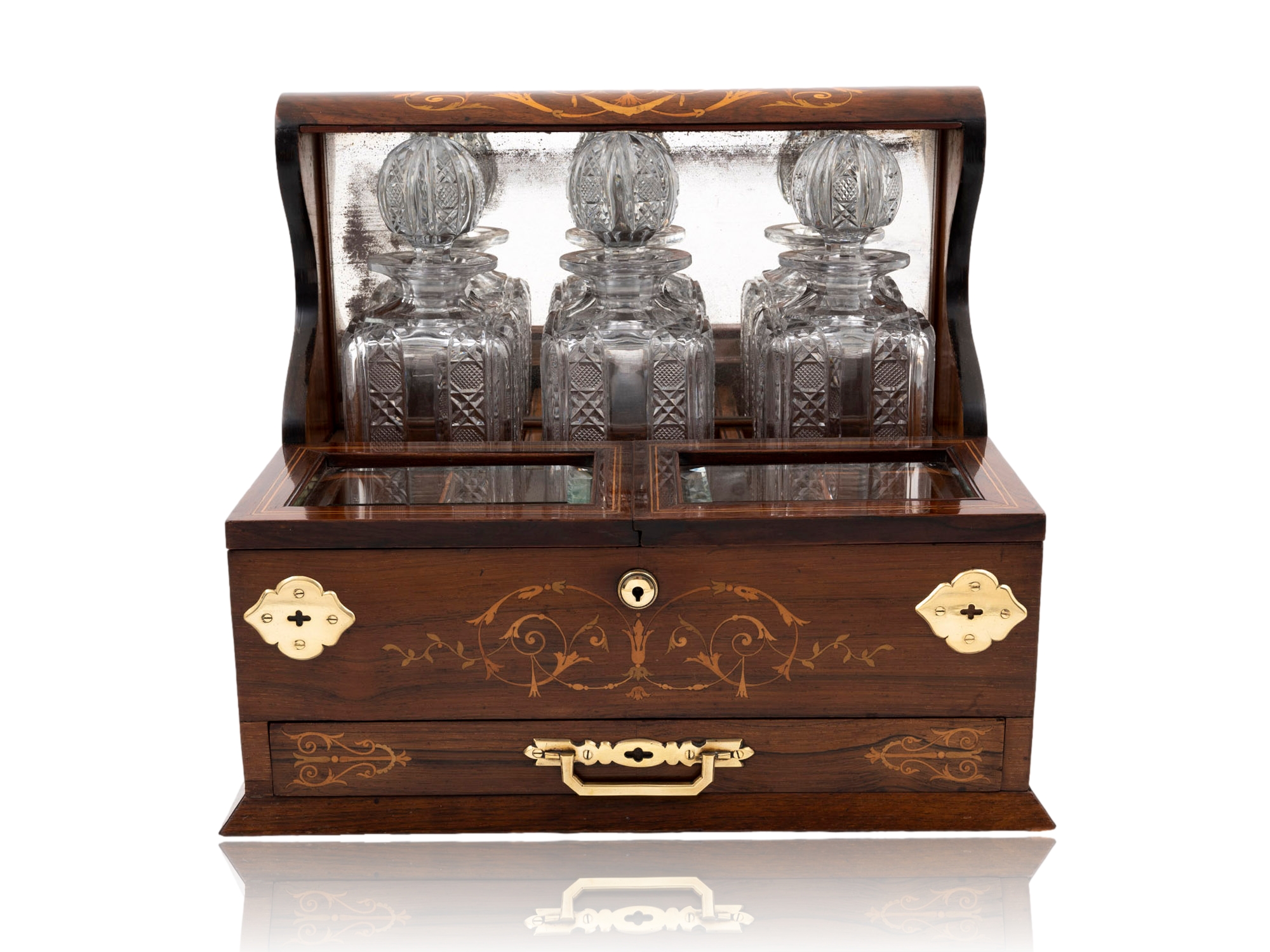
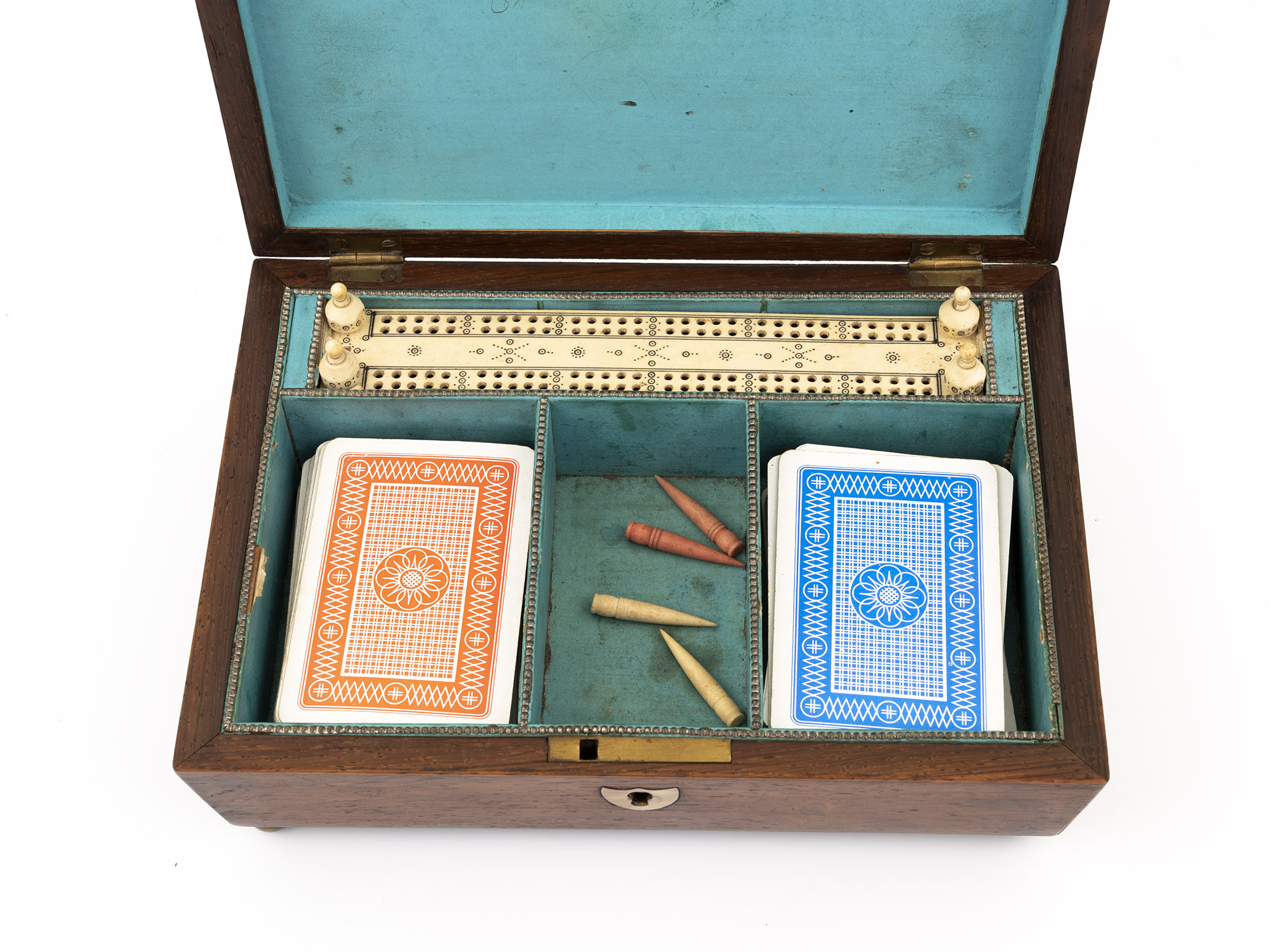
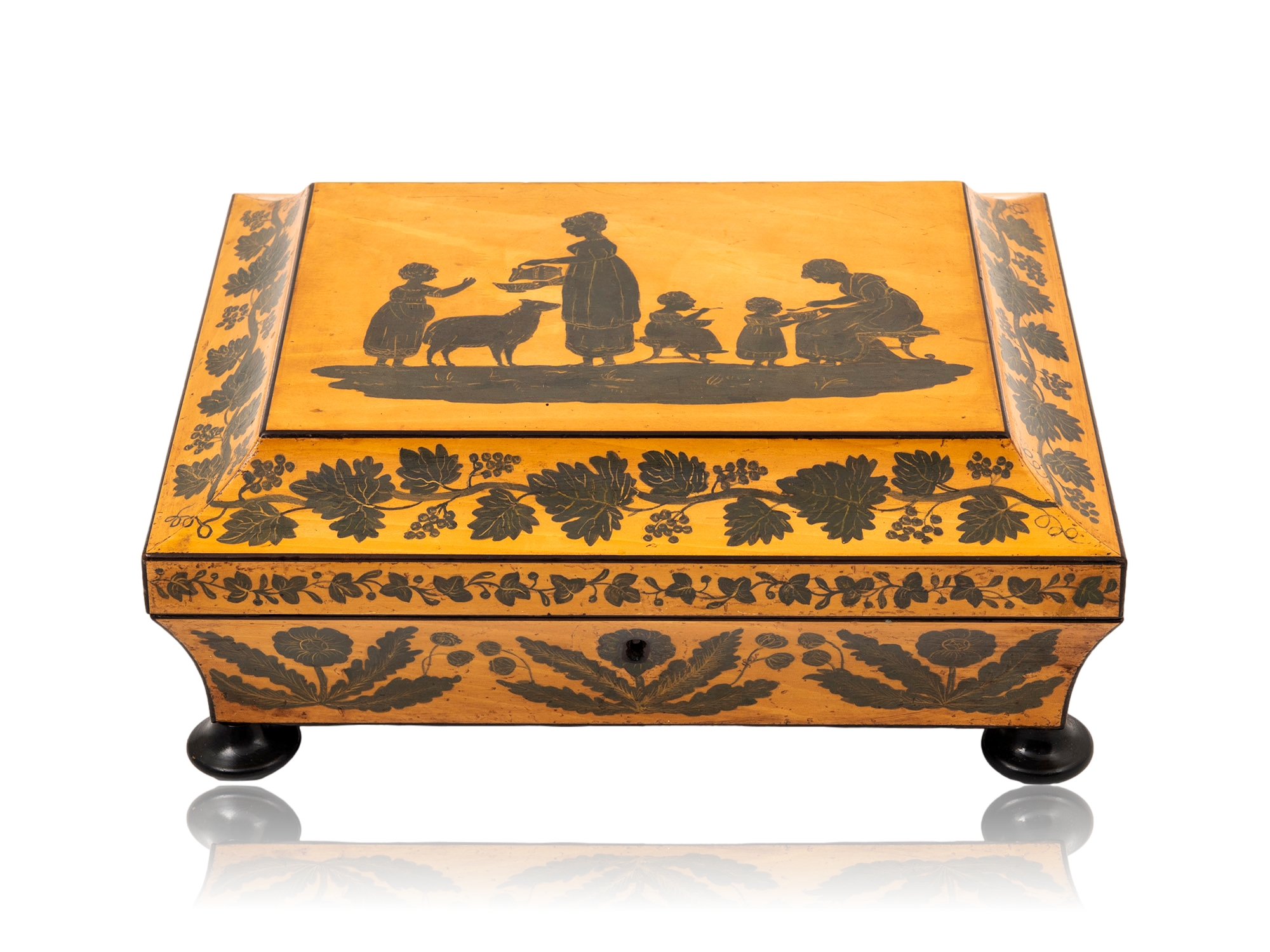
Description Retailed by Drew & Sons From our Games Boxes collection we are a delighted to bring to market this exceptional Coromandel Games Compendium made for King Edward VII by George Betjemann & Sons and sold by London film Drew & Sons. The game’s box is veneered to the exterior in exotic coromandel with reinforced rounded corners, nickel strapping across the body and flush mounted twin handles. The lid features the personal Royal cypher of King Edward VII (Edward Rex with his regnal number for seven in Roman numerals VII) and the front features a Bramah lock for securing the contents. The interior features a full and complete games compendium with a satinwood lined interior.The front of the compendium drops down and contains twin cribbage boards and twin finger scorers. The main body contains pivoting tiers which house a full set of red stained and white chess pieces, a full draughts set of matching colour, dice and cribbage counters. Once the wings are opened, the trays below are filled with further game sets, including multiple sets of playing cards, bezique counters, playing counters, dominoes, dice shakers, steeplechase borses and the original roulette wheel. The inside lid of the box contains a draughts/ chess and backgammon board veneered in coromandel, ivory and tulipwood, along with a leather steeplechase gaming board in the rear. The interior of the box is signed by the retailer Drew & Sons Piccadilly and is also stamped on the back of the mounts for the manufacturer George Betjemann & Sons. The games compendium dates to the turn of the 20th century during the short reign of King Edward VII circa 1905. Literature We are delighted to offer this games compendium as part of our Exceptional Collection catalogue featured on page 12-13. King Edward VII (1841–1910) was the son of Queen Victoria and Prince Albert, reigned as King of the United Kingdom and Emperor of India from 1901 until his death in 1910. Known for his refined taste, sociable charm, and strong patronage of the arts, Edward helped define the sophistication of the Edwardian era, a period marked by elegance, progress, and luxury. Before his accession, Edward served as Prince of Wales for nearly 60 years, during which he travelled extensively and became an influential figure in European society. His reputation as an arbiter of style set new standards for leisure, fashion, and entertaining, from dress and dining to the design of personal and domestic objects. As monarch, Edward modernised the monarchy’s public image and fostered diplomatic relations across Europe, earning the nickname “The Peacemaker.” His reign ushered in an age of polished manners and artistic excellence, reflected in the fine craftsmanship and cultural refinement associated with Edwardian design. This exceptional Coromandel Games Compendium was created for King Edward VII, a testament to the opulence, artistry, and social sophistication of the Edwardian court, where gaming, travel, and fine craftsmanship reflected the leisurely grandeur of the age. George Betjemann & Sons George Betjemann & Sons stood among the finest London makers of dressing cases, writing boxes and luxury furnishings throughout the 19th century, with a reputation built on precision, innovation and elegant design. The company began with George Betjemann (1798–1886), who was apprenticed in 1810 to Gilbert Slater, a respected dressing case maker. Betjemann soon established his own workshop in Clerkenwell, a hub for cabinet-making and fine metalwork at the time. By 1865, the business had grown significantly and was operating under the name George Betjemann & Sons, with addresses at 36 and later 36-40 Pentonville Road. The firm remained in family hands for generations, employing over a hundred craftsmen at its peak. George’s sons, believed to be G.W. and J. Betjemann, joined the business and brought with them a spirit of technical innovation, filing several patents for improvements in box construction and display fittings. At the 1878 Paris International Exhibition, Betjemann & Sons showcased their remarkable range: self-closing book slides, expanding dressing cases, writing sets in exotic veneers, and engraved gilt metalwork in a neo-Gothic style. Their decorative objects extended well beyond boxes, the firm also produced photographic frames, albums, candelabra, silver étuis, clocks, and scent bottle stands. These often incorporated high-end materials such as Algerian onyx, malachite, and richly figured marbles, a nod to the firm’s affinity for both English craftsmanship and Continental flair. Throughout their history, Betjemann & Sons continually expanded both their range and reputation. Patents were filed for everything from folding games boxes to decanter stands, while bespoke commissions were crafted for an elite clientele. A notable example is a satinwood dressing table designed by Ernest Edward Betjemann, incorporating a concealed safe and patented in 1910. Another, a fine writing slope signed G. BETJEMANN & SONS, has appeared on the market with provenance from respected collections. The firm’s reach also extended to financial dealings in the trade. G. Betjemann acted as trustee in the liquidation of several competing London case makers, including Toulim & Gale and P. F. Schafer, consolidating his position in a competitive market. Though the company eventually ceased operations in the early 20th century, its legacy endures. George Betjemann was the great-grandfather of the poet Sir John Betjeman, whose own nostalgia for craftsmanship and English domesticity seems a fitting echo of the family’s tradition. Today, Betjemann boxes are prized for their exceptional build quality, inventive mechanics, and distinctive style. Whether a writing slope, games compendium or dressing case, these pieces remain among the finest examples of 19th-century portable luxury. Drew & Sons Drew and Sons began trading in 1844, as proudly noted on their letterhead. Like many firms of the nineteenth century who catered to the needs of the travelling gentleman, they started out supplying luggage and travel requisites before expanding into portable furniture as demand grew. They became especially well known for their fine quality leather goods and luxurious picnic sets, but their range extended far beyond that. The entire second floor of their Piccadilly Circus showroom was dedicated to military furniture and campaign equipment, and they made a point of stating on their documents that everything they sold was made in house and to the highest standard. The pieces we have seen over the years certainly live up to that claim. Drew and Sons enjoyed the patronage of Queen Victoria and the Royal Family, as well as many of the royal courts across Europe. Their main address was 33 to 37 Piccadilly Circus, though they also had premises at 155 Leadenhall Street in London and 42 Kings Road in Brighton. Their workshops were based in Burlington Buildings on Heddon Street and in Hatton Garden. Coromandel Also known as Calamander is a valuable wood found in India, Sri Lanka and South East Asia. It has a contrasting hazel-brown colour with black grain. It is a dense, heavy wood that is so popular it has been logged to extinction over the last few hundred years. This makes Calamander pieces even more special. Satinwood is found in India and Sri Lanka. It has a rich golden colour and an almost reflective sheen. Satinwood is traditionally used for high quality furniture. Bramah is London’s oldest security company. Established at 124 Piccadilly, London in 1784, and today based in Fitzrovia, London and Romford, Essex. Bramah manufactures Bramah and Rola locks for domestic and commercial applications in the U.K. and overseas. We are Marylebone and Fitzrovia’s foremost Locksmith and Burglar Alarm installer. If you are purchasing Tortoiseshell or Ivory pieces and are outside the UK you must have a CITES certificate in order to import the item into your country. We can obtain these on your behalf at a cost of £50 and these can take up to 30 working days to arrive at our office. Due to the strict exporting rules of these pieces, they may also come with further shipping costs. Please ensure you contact us prior to purchase for a quote. With every purchase from Mark Goodger Antiques, you will receive our latest catalogue, a Certificate of Authenticity, detailed care instructions for your chosen piece and an independent invoice (for insurance purposes) will be enclosed. As well as being protected by a no-hassle, money-back policy, your piece will be entirely insured during the shipping process to ensure the safety of your item.
Games Boxes