Ebonised Tea Chest with Silver Tea Caddies
$64.19
$89.22
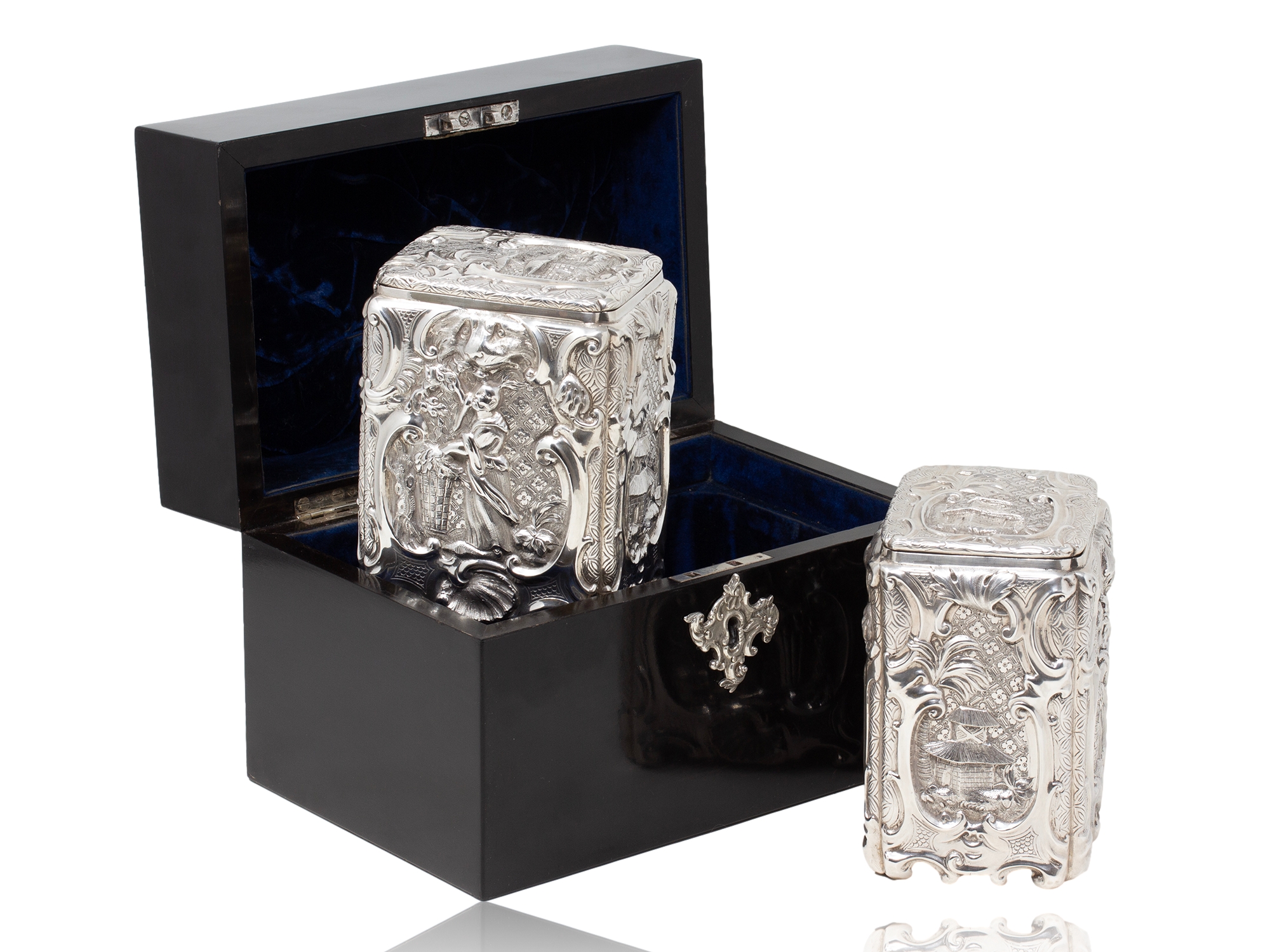
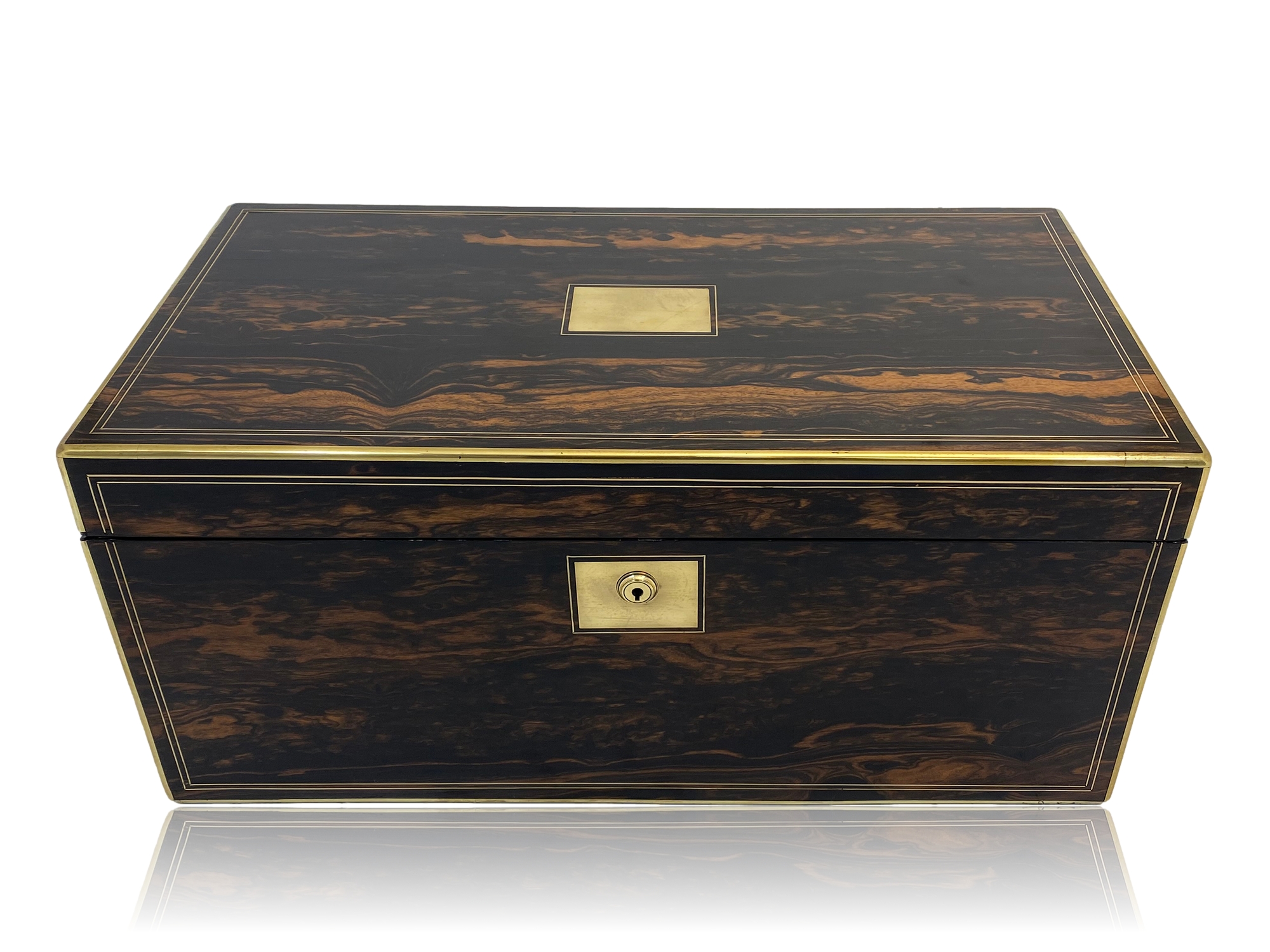
Description This ebonised tea chest with silver mounted tea caddies dates to the mid nineteenth century and was awarded as a Royal Prize in 1843. The chest is of rectangular form with an ebonised exterior fitted with sterling silver handle, escutcheon and mounts. The lid is set with a silver plaque engraved “Royal Prize 1843”, each element hallmarked sterling, London, by Sebastian Crespel II and dated 1842. Opening the chest reveals a dark blue ruched velvet lined lid with silver hinges hallmarked London by George Reid. The interior is fitted with two compartments housing a pair of finely worked silver tea caddies. Each tea caddy is of square form raised on scrolling feet and decorated throughout in rococo chinoiserie style with repoussé scenes depicting pagoda buildings and figures in landscape settings. The decoration reflects the influence of earlier eighteenth century silversmiths, particularly in the manner associated with Paul de Lamerie. Both caddies are hallmarked sterling, London, by Joseph Angell I and Joseph Angell II and dated 1840. The base of the chest is engraved “Royal Prize Won at Fernhill 18 August 1843” beneath a family crest and monogram, confirming its presentation and historical context. A well preserved tea chest with silver tea caddies combining strong decorative detail with documented presentation and provenance. View the full Tea Caddy and Silver collection. Literature Mark Goodger 25th Anniversary Catalogue Joseph Angell I & Joseph Angell II was founded by Joseph Angell I who was apprenticed to Henry Nutting in 1796, obtaining his freedom in 1804. Joseph Angell I entered his first mark in 1811 active as plate worker at 55 Compton Street, Clerkenwell. In 1831 he entered a joint mark with his brother John Angell (mark JA over IA, on 31 January 1831). Around 1837 Joseph Angell II (son of Joseph Angell I) joined to the partnership and the business was continued under the style Angell, Son & Angell. In 1840 Josephs brother departed the business and it continued as Joseph Angell & Son operating with the new mark JA over JA which was entered on the 6th of July 1840 and soon after in 1842 the business moved to 25 Panton Street, Haymarket. Joseph Angell I retired in 1848 and the business continued to be run by his son Joseph Angell II under his own name opening new retail premises at 10 Strand, Charing Cross (1849). Joseph Angell II exhibited in the 1851 Great Exhibition and was awarded a Prize Medal for his enamelled articles, he also attended the 1853 New York Exhibition winning the bronze medal and to the 1862 International Exhibition winning a further medal. The Angell family business became one of the largest and most important silver and jewellery manufacturers and retailers in London in the mid 19th century. Sebastian Crespel II Sebastian & James Crespel were London silversmiths with little known documentation about their lives and careers. Their mark is assumed to have been entered in the famous missing largeworkers’ register around 1760. The Crespels are noted in Edward Wakelin’s workmen registers and deemed most likely that they learnt their trade in Wakelin’s workshop. The 1769 record entry displays them as supplying plates and dishes which coincides with the majority of their works. Their careers certainly seem to have been tied to Wakelin and from 1782 it’s likely that all pieces bearing their mark went through the latters’ hands. From 1788 Wakelin’s ledger account is headed ‘James Crespel’, indicating Sebastian’s probable death or retirement. The ledgers finish in October 1806 without any apparent successor to the business even though it was known that James Crespel had at least four sons apprenticed in the trade. George Reid was a Silversmith based in London specialising in Boxes, decanter labels, lids and accessories. His works were often supplied to high end retailers such as Lund entering his first mark around 1823 and working until circa 1839. Further marks were registered in Mar 1811, 1817, 1824, 1828, 1829. It is believed that the business was Succeeded by Ann Reid possibly his widow AR mark within a matching oval punch. Chinoiserie is a decorative style in Western art, furniture, and architecture that was undertaken particularly in the 18th century. It is characterized by the use of Chinese motifs and techniques hence the name Chinoiserie. Paul Jacques de Lamerie (1688-1751) was a renowned London-based silversmith. The Victoria and Albert Museum describes him as the “greatest silversmith working in England in the 18th century”. He was being referred to as the “King’s silversmith” in 1717. Though his mark raises the market value of silver, his output was large and not all his pieces are outstanding. The volume of work bearing de Lamerie’s mark makes it almost certain that he subcontracted orders to other London silversmiths before applying his own mark. Fernhill was the original name given to one of the handicap racers at Royal Ascot beginning in 1834 and later named ‘The Sandringham Stakes (Listed Handicap)’. The Fern Hill Stakes race was part of the traditional Heath Day card on the Saturday after Royal Ascot. It was renamed the Sandringham Stakes after the royal residence and as part of the Golden Jubilee celebrations in 2002. This is a competitive Listed handicap over a mile, limited to three-year-old fillies only. Sterling Silver is an alloy composed by weight of 92.5% silver and 7.5% other metals, usually copper. The sterling silver standard has a minimum millesimal fineness (parts per thousand) of 925. Why Buy from Mark Goodger Antiques? With over thirty five years of specialist experience, Mark Goodger Antiques is recognised internationally as a leading authority in antique boxes and related works of art. Every item offered has been personally selected by Mark, whose knowledge and judgement are trusted by collectors, institutions, museums, interior designers, and fellow dealers worldwide. Every purchase is supplied with a full supporting package for clarity and reassurance. This includes a Certificate of Authenticity, a detailed condition and care guide specific to your item, our most recent catalogue, and a separate invoice suitable for insurance and valuation purposes. Each piece is carefully examined prior to sale to ensure accuracy of description and quality. Your purchase is fully insured during transit and protected by our straightforward money back guarantee, allowing you to buy with complete confidence. We pride ourselves on transparency, expertise, and long term relationships with our clients, many of whom return to us repeatedly over decades. When you buy from Mark Goodger Antiques, you are purchasing from a specialist family business built on knowledge, trust, and an unrivalled focus on antique boxes.
Boxes